Dryers are the good news of this trade: simple machines, cheap faults, long lives. The verdict here usually lands on repair — and when it doesn't, you'll know exactly why.
The damp side of Washington is hard on dryers in a specific way: machines here run longer cycles against wetter air, vents grow moss-adjacent obstructions at the outside flap, and the lint load of a rainy winter is a genuine fire consideration. So the visit starts outside the cabinet — the vent run and the flap get checked before anything inside takes blame, because half of Bellingham's 'broken' dryers are actually strangled ones.
Once airflow is cleared, the classic suspects line up in order of likelihood and price: thermal cutouts, elements or igniters, belts and rollers, then and only then the controls. The fault gets named at your door, the verdict gets weighed against the machine's age and worth, and the figure lands on paper before any component gets purchased — each one itemized for your signature, always.
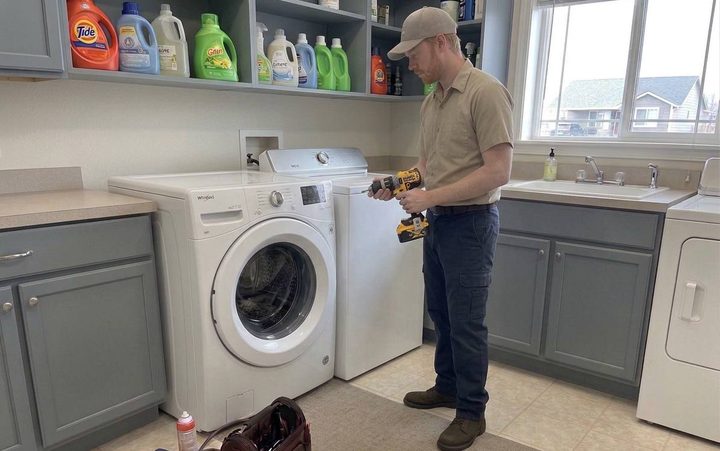
A dryer has no sealed system, no plumbing, and mostly no expensive electronics — its classic failures are belts, rollers, elements, igniters and thermostats, all modest money against what a new machine costs. Under the Half-Rule, even a twelve-year-old dryer with a solid drum usually earns its fix.
A scorched drum bearing on a builder-grade unit, or a control board on a machine already rusting at the seams — those are the rare dryer verdicts that fail the arithmetic. You'll hear it plainly, with the visit fee as the whole bill and a word on what replaces it well.
Strong warm airflow at the outside vent means the run is clear. A trickle means the machine is fighting its own exhaust — and that check costs you thirty seconds, not a visit.
Drum wear announces itself politely at first. Caught while it still squeals, the fix stays modest; ignored until it grinds, the drum itself can end up paying.
An odd smell from a gas dryer earns an immediate shutdown — and if it smells like gas itself, your first phone call belongs to the utility company. No load of towels is worth the alternative.
A steady share of this shop's dryer verdicts convict the exhaust run instead of the machine — and those entries close cheap, sometimes free with a cleared flap. Logging them keeps the practice humble: the most expensive part in the van can't fix a strangled duct.
A dryer that behaves empty can still quit at minute forty under towels, so approvals get proven with weight in the drum before the ledger marks a job closed. The extra minutes keep the callback column embarrassingly short.
When a dryer does fail the arithmetic — scorched bearing, rusted seams, a control on a machine past its era — the entry shows the reasoning: what the fix costs, what the machine is worth, why the honest answer is a well-chosen replacement. The visit fee buys that reasoning in full.
Usually worth a vent check first, which the phone call can talk you through free. If the flap blows strong and clothes still come out damp, the fault is inside and the visit will name it.
No — age alone never decides here. A well-built old dryer with a mechanical fault often clears the Half-Rule easily; the verdict weighs the specific fault against the specific machine.
Both, all week. The heat source changes the parts list, not the honesty of the verdict.
Yes — it comes off any approved repair, dryers included. The one thing it never touches is the visit-and-verdict fee, which stays the same for everyone.
Tell us the machine, the symptom and — this matters here — roughly how old it is. The callback confirms a window, and the verdict at your door comes with the arithmetic attached.
Your figure goes in writing first, parts on their own signed line — and the $20 coupon comes off the total.
The flat visit fee — quoted when you book — is the whole bill, and it buys the verdict plus a straight word on what to buy instead.
One call books it; one written answer follows it. What happens next is entirely your decision.