From fill valve to ejector, an ice maker is a short chain of small parts — and the wasted money in this category comes from replacing the whole chain to fix one link.
Ice complaints are seasonal on the bay side: cold snaps freeze fill lines in January, and the first real barbecue weekend of summer exposes every maker that limped through the winter. The visit reads the whole chain in order — pressure, filter age, fill volume, then one complete freeze-and-harvest cycle watched with the panel open, because a link caught failing on stage needs no further argument.
Taste complaints get the honest treatment too: stale ice is usually absorption and housekeeping rather than hardware, and when the cure is a scrubbed bin, a fresh filter and two days' patience, that's the verdict you'll get — free of invented parts. The ledger stays clean both directions.
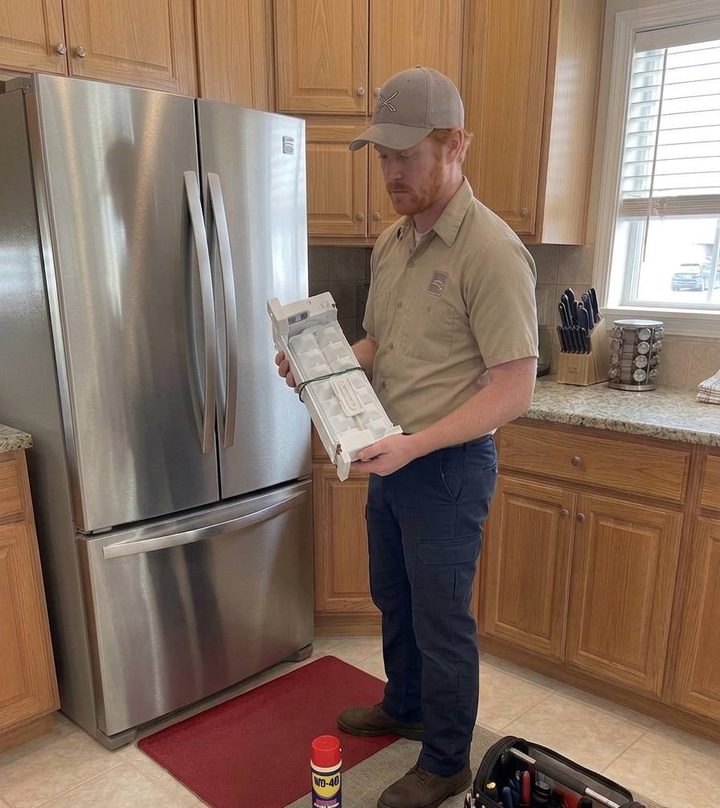
The reflex fix — swap the whole maker assembly — inherits every upstream problem the old one had: starved water pressure, an expired filter, a frozen fill line. The verdict here starts with the water side, because half of these cases resolve without touching the mechanism at all.
A genuinely failed maker module on a healthy water supply is a clean, honest repair that passes the Half-Rule on any fridge worth keeping. And when the fridge itself is on borrowed time, the verdict says to spend nothing further — the ice maker question is really a refrigerator question, answered honestly.
Most weak-ice complaints trace to a cartridge working past its retirement. A marker note beats memory, and the maker will thank you in cube volume.
Whatever cycles first through a freshly disturbed system carries loosened sediment and stale flavor with it. Toss that batch unsentimentally.
A jammed auger in a cold snap is often a thaw away from working — forcing it converts a free fix into a real one.
Pressure, filter age and measured fill volume open the investigation because half the category's failures live upstream of the maker. Module-swapping on suspicion is the signature wasted money this page exists to prevent.
Fill, freeze, release — watched with the panel open, so whichever link fails does so in front of a witness. Everything that performs cleanly keeps its job and stays off your figure.
Every ice entry on an aging fridge answers the cabinet question first. A new maker on a dying refrigerator is a sale the ledger won't record — the verdict says where the money actually belongs.
Maybe — or the filter retired, the pressure sagged, or the fill line froze. The chain gets read in order at the visit, and the verdict names the actual link.
Usually the bin absorbing freezer smells rather than any fault. The honest cure is housekeeping, and when that's the answer you'll get it straight — no parts invented.
Fully. Door-mounted makers are temperamental about their air supply and door seals, so those two get inspected ahead of the mechanism itself.
Any approved repair, ice makers included. Never the visit fee — that stays flat and unbiased.
Tell us the machine, the symptom and — this matters here — roughly how old it is. The callback confirms a window, and the verdict at your door comes with the arithmetic attached.
Your figure goes in writing first, parts on their own signed line — and the $20 coupon comes off the total.
The flat visit fee — quoted when you book — is the whole bill, and it buys the verdict plus a straight word on what to buy instead.
One call books it; one written answer follows it. What happens next is entirely your decision.